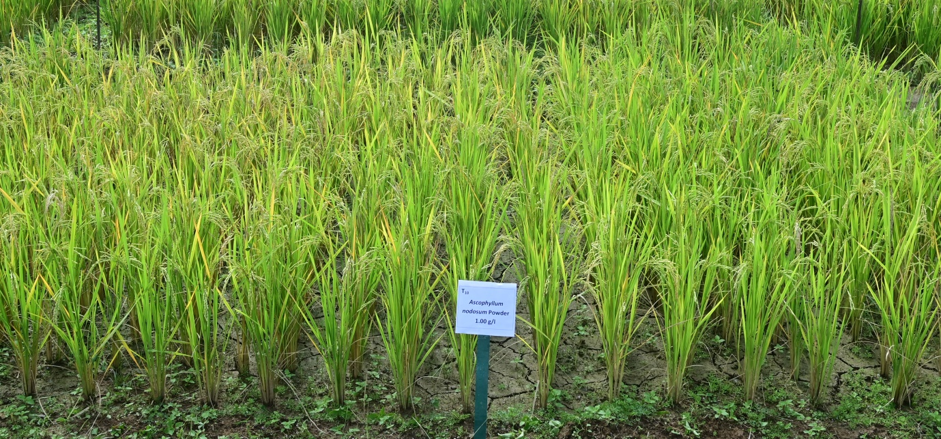

Ascophyllum nodosum Powder was evaluated in rice across three contrasting agro-ecological zones of Himachal Pradesh, India, to assess its effect on crop growth, yield attributes, grain productivity, nutrient content and economic returns.
The university-led study was conducted at Akrot, Palampur and Dharer, representing conditions ranging from sub-montane low hills to high-hill temperate environments. The experiment followed a Randomized Block Design with four replications.
Multi-Location Validation
Crop: Rice, variety PAC 807+
Locations: Akrot | Palampur | Dharer
Agro-Ecological Zones: 3
Application Rates: 1, 2 & 3 g/L
Study Year: 2024
Evaluated by: CSK Himachal Pradesh Krishi Vishvavidyalaya (CSKHPKV), Palampur
Improved Grain Yield Across All Three Environments
Application of Ascophyllum nodosum Powder significantly improved rice grain yield across the evaluated agro-ecological zones. The strongest responses were observed at 2–3 g/L, depending on location.
| Location | Dose | Grain Yield | Control | Yield Increase |
| Akrot | 3 g/L | 6,626 kg/ha | 5,438 kg/ha | +21.9% |
| Palampur | 3 g/L | 5,067 kg/ha | 4,217 kg/ha | +20.2% |
| Dharer | 2 g/L | 4,372 kg/ha | 3,707 kg/ha | +17.9% |
The report further recorded improvements in important yield-contributing characteristics, including effective tillers, panicle characteristics, grains per panicle, grain weight and 1000-grain weight, although the magnitude of response varied between locations