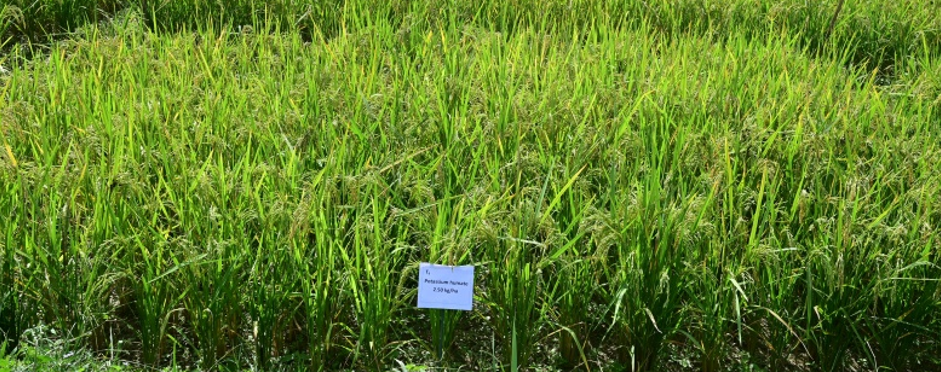

Potassium Humate was evaluated in rice across three contrasting agro-ecological zones of Himachal Pradesh, India, to assess its influence on crop growth, yield attributes, grain productivity, nutrient content and economic returns.
The university-led study was conducted at Akrot, Palampur and Dharer, representing sub-montane low hills, mid-hill sub-humid and high-hill temperate environments.
Multi-Location Evaluation
Crop: Rice, variety PAC 807+
Locations: Akrot | Palampur | Dharer
Agro-Ecological Zones: 3
Rates: 1.25 | 1.875 | 2.50 kg/ha
Application: Soil application at tillering + foliar applications at booting and seed-set
Design: Randomized Block Design | 4 replications
Study Year: 2024
Consistent Yield Response Across Three Environments
Potassium Humate significantly improved rice grain yield, with the study concluding that 1.875–2.50 kg/ha produced the strongest overall response across the three locations.
| Location | Dose | Grain Yield | Control | Yield Increase |
| Akrot | 2.50 kg/ha | 6,230 kg/ha | 5,337 kg/ha | +16.7% |
| Palampur | 2.50 kg/ha | 4,917 kg/ha | 4,148 kg/ha | +18.5% |
| Dharer | 2.50 kg/ha | 4,306 kg/ha | 3,635 kg/ha | +18.5% |
The report also recorded significant improvements in several important yield attributes, including effective tillers, panicle length, grains per panicle, grain weight per panicle and 1000-grain weight.
Up to 18.5% Higher Rice Grain Yield
Across contrasting growing environments, Potassium Humate demonstrated a consistent positive agronomic response, supporting improved crop development and grain productivity.
The study also evaluated economic performance, with the highest net returns generally recorded at 2.50 kg/ha, demonstrating the commercial relevance of the observed agronomic response.